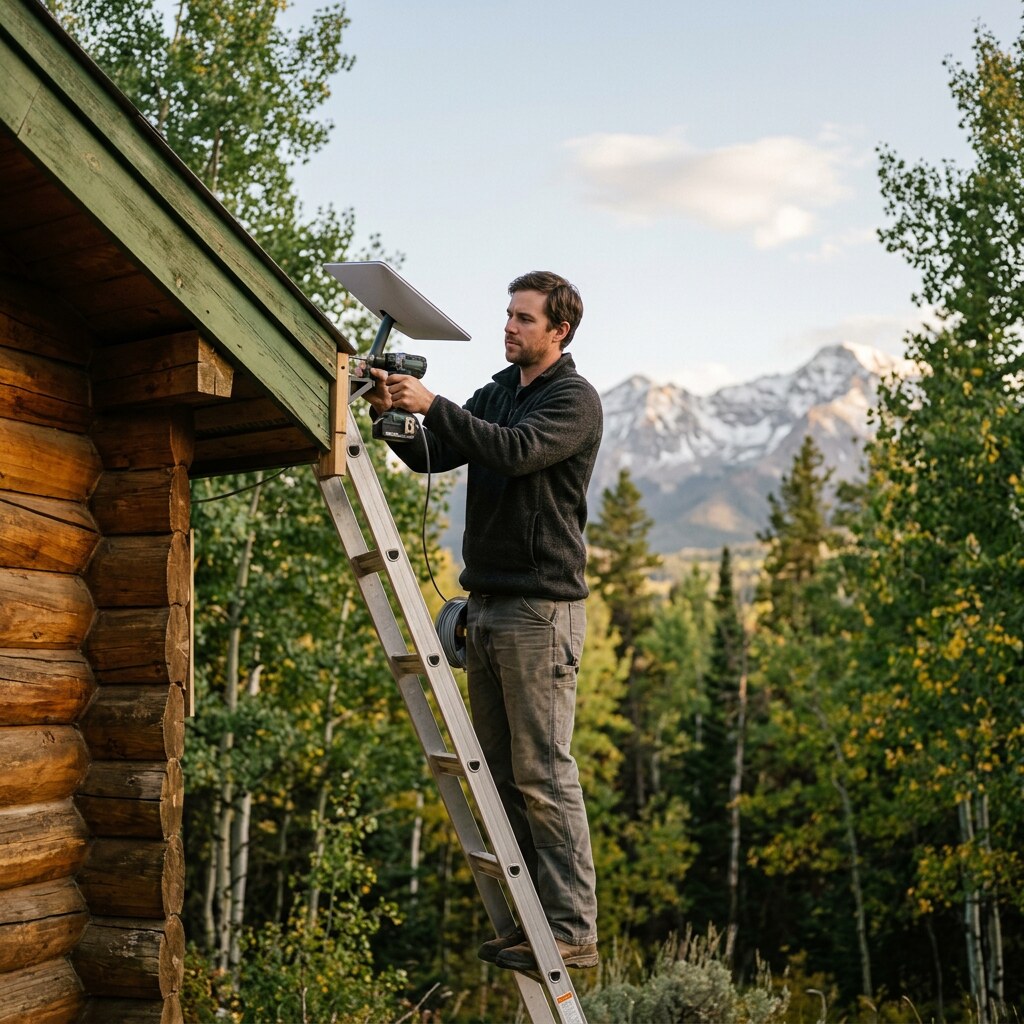
Starlink’s app tells a lot of property owners their place “may not work” because of tree obstructions. In Eagle County we’ve installed at dozens of properties the app initially flagged as problematic. The thing the app doesn’t know — and what makes the difference between “it’ll never work” and “works perfectly on a 12-foot pole” — is the position of the trees relative to the dish’s required cone of sight, not just the existence of the trees themselves.
What Starlink actually needs
The dish needs a clear view of a portion of the northern sky. The exact shape of that view depends on which satellite generation you have and what part of the constellation is overhead at any given moment, but as a rule of thumb the dish wants an unobstructed cone about 100 degrees wide, pointed somewhat north of straight up. In Eagle County (latitude ~39.6°N) that cone tilts about 30 to 40 degrees off vertical, opening toward the north.
Trees, ridges, chimneys, or buildings inside that cone block satellites momentarily as they pass through. A few brief obstructions a day are tolerable — you might see a one-second hiccup on a video call. Continuous obstructions across most of the cone are not tolerable. That’s where the “won’t work” properties live.
Why the Starlink app overcalls obstructions
The app uses your phone’s camera and tilt sensors to scan the sky from a single position you stand in. It assumes the dish will sit roughly where the phone was, at roughly the height you held the phone. That assumption is wrong on almost every install we do.
The dish doesn’t need to live in the spot you scanned. It needs to live somewhere on your property where its view is clear — and that “somewhere” is usually a pole mount near the roofline, a gable peak, or a clear corner of the property 10 to 20 feet away from where the app told you it was hopeless. The app rates the spot you tested. We rate the property.
“The app rates the spot you tested. We rate the property.”
The four real obstruction patterns in Eagle County
After enough installs you start seeing the same four patterns repeat. The fix for each is different.
1. One tall tree directly to the south or southeast
Easiest pattern. The tree only blocks a narrow slice of the cone and we can almost always find a dish position 10 to 15 feet away (on the other side of the roof, on a gable mount, or on a short pole) that gets clear sky. Cost: roughly the same as a standard install, sometimes plus the pole.
2. Dense canopy at a low angle
The pattern customers worry about most — a wall of mature pines or aspens 30 to 40 feet tall ringing the property. Moderate fix. We pole-mount the dish above the canopy. We’ve installed up to 25-foot ground-anchored poles for this. Costs more than a standard install because of the pole hardware, footing, and bonding, but almost always works. It’s the most common “Vail and Cordillera property” install pattern — see our Vail page for more on the tree-heavy lots in Lionshead and Booth Falls.
3. Mountain ridge to the north
The hardest pattern. A ridge that occupies the lower half of the dish’s northern cone of sight isn’t something you can pole-mount around — the ridge is bigger than your pole. We see this most often in Minturn, Red Cliff, and the steeper north-side properties in East Vail. The fix here is either a wireless relay from a clearer point on the property (if you own enough land to put a dish somewhere with sky) or accepting that Starlink isn’t the answer and looking at fixed wireless or fiber where available.
4. Roof itself blocking
Surprisingly common. A dish set on a south-facing roof slope can’t see north because the roof itself is in the way. Easy fix: move it to the north slope, the ridgeline, or a chimney mount. Customers who self-installed often run into this and assume they have a tree problem when they have a geometry problem.
Pole mounts — what we actually use
For most canopy-clearing jobs we use 1.5-inch or 2-inch galvanized pipe, 10 to 20 feet of exposed length depending on canopy height, anchored either to a concrete footing or to a structural roof point with engineered brackets. We bond the pole to the building’s grounding system — lightning is real in Colorado and an ungrounded metal pole at canopy height is asking for damage.
Two details that matter. The dish has to be high enough that the trees won’t grow into the cone in the next decade (we plan for 10 feet of growth on aspens, less on mature conifers). And the cable run from dish to router has to be sized for the pole length — Starlink’s standard cable is 75 feet, longer runs need their longer cable or a powered Ethernet adapter setup.
The “let’s just try it” rule
Starlink has a generous return window. If we look at your property and the app says “obstructed” but our experience says the property has a fixable pattern, we’ll often recommend buying the kit and letting us install it on a temporary mount as a test. If it works, we convert the temporary mount to a permanent one. If it doesn’t, you return the kit within the window and we’ve only spent labor on the test install.
That removes the “will it even work” question from the equation and replaces it with a real-world test. We do this with maybe a third of the properties where the app raised concerns. It almost always works.
What to send us if you want a remote assessment
Before we drive out, send us:
- The property address (we’ll pull a satellite image and topo map ourselves)
- Three or four photos of the surrounding trees and any clear sky views from different sides of the building
- A note on which exterior wall faces north (or just “not sure” if you don’t know — we’ll figure it out from the satellite view)
- Where you’d like the dish to live if it works: roof? side of the garage? a pole near the driveway?
Within one business day we’ll send back a written assessment with our best guess on the fix and a quote for the install. If it’s ambiguous from the photos we’ll schedule a free site visit to confirm. Or read more about how we work in our earlier post on Eagle County WiFi gear.
The short version: don’t take the Starlink app’s “may have obstructions” verdict as final. Most properties that read as obstructed are fixable. The fix usually costs less than you think.